


Wine glass bottle manufacture process
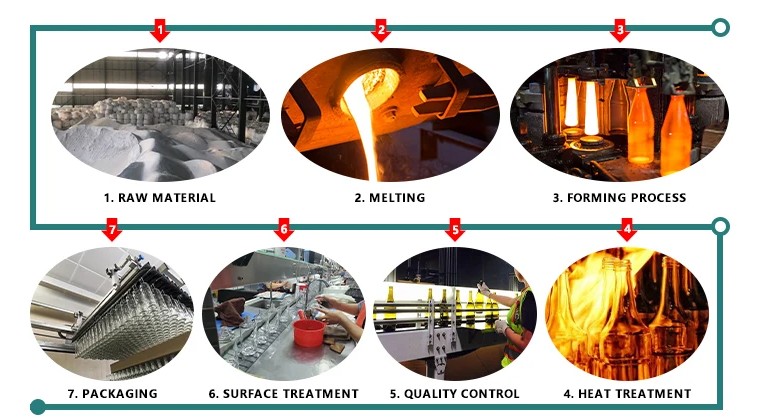
The manufacturing process of wine glass bottles involves several steps, from raw materials to the finished product. Here's an overview of the typical process:
2. **Melting**: The mixed batch is fed into a furnace, where it is heated to extremely high temperatures (around 1700 to 2000°C or 3092 to 3632°F) to melt the raw materials. The intense heat causes the ingredients to fuse together and form molten glass.
3. **Forming**: Once the glass is molten, it is shaped into bottles using one of two primary forming methods:
- **Blow-and-Blow Method (for non-round bottles)**: In this process, a gob (a blob of molten glass) is dropped into a mold cavity. A plunger is then inserted into the mold to create the bottle's neck and finish. Compressed air is blown into the gob, causing it to expand and take the shape of the mold.
- **Press-and-Blow Method (for round bottles)**: In this process, a gob is dropped into a mold cavity, and a metal plunger is used to press the molten glass against the mold walls. The plunger creates the bottle's neck and finish, while air is blown into the gob to shape it into the final bottle form.
4. **Annealing**: After forming, the bottles pass through an annealing lehr—a long, temperature-controlled tunnel furnace. The annealing process gradually cools the bottles at a controlled rate to relieve internal stresses and strengthen the glass, preventing breakage or shattering.
5. **Surface Treatment**: Once annealed, the bottles may undergo additional surface treatments or processes to enhance their appearance or functionality. Common surface treatments include:
- **Trimming**: Trimming removes excess glass from the bottle's neck and finish, ensuring uniformity and smoothness.
- **Flame Polishing**: Flame polishing involves briefly passing the bottle through a flame to melt and smooth any rough edges or imperfections.
- **Coating**: Bottles may be coated with materials such as enamel or wax for decorative or functional purposes, such as labeling adhesion or UV protection.
- **Inspection**: Throughout the manufacturing process, bottles are inspected for defects, such as bubbles, cracks, or irregularities. Automated inspection systems and manual checks ensure quality control and consistency.
6. **Packaging**: Once the bottles have been inspected and approved, they are packaged for shipment. This may involve stacking the bottles in crates or cartons, palletizing them, and preparing them for distribution to wineries, bottling facilities, or retailers.
The manufacturing process of wine glass bottles requires precision, quality control, and adherence to strict standards to produce high-quality bottles that meet the requirements of wineries and consumers alike.
2. **Melting**: The mixed batch is fed into a furnace, where it is heated to extremely high temperatures (around 1700 to 2000°C or 3092 to 3632°F) to melt the raw materials. The intense heat causes the ingredients to fuse together and form molten glass.
3. **Forming**: Once the glass is molten, it is shaped into bottles using one of two primary forming methods:
- **Blow-and-Blow Method (for non-round bottles)**: In this process, a gob (a blob of molten glass) is dropped into a mold cavity. A plunger is then inserted into the mold to create the bottle's neck and finish. Compressed air is blown into the gob, causing it to expand and take the shape of the mold.
- **Press-and-Blow Method (for round bottles)**: In this process, a gob is dropped into a mold cavity, and a metal plunger is used to press the molten glass against the mold walls. The plunger creates the bottle's neck and finish, while air is blown into the gob to shape it into the final bottle form.
4. **Annealing**: After forming, the bottles pass through an annealing lehr—a long, temperature-controlled tunnel furnace. The annealing process gradually cools the bottles at a controlled rate to relieve internal stresses and strengthen the glass, preventing breakage or shattering.
5. **Surface Treatment**: Once annealed, the bottles may undergo additional surface treatments or processes to enhance their appearance or functionality. Common surface treatments include:
- **Trimming**: Trimming removes excess glass from the bottle's neck and finish, ensuring uniformity and smoothness.
- **Flame Polishing**: Flame polishing involves briefly passing the bottle through a flame to melt and smooth any rough edges or imperfections.
- **Coating**: Bottles may be coated with materials such as enamel or wax for decorative or functional purposes, such as labeling adhesion or UV protection.
- **Inspection**: Throughout the manufacturing process, bottles are inspected for defects, such as bubbles, cracks, or irregularities. Automated inspection systems and manual checks ensure quality control and consistency.
6. **Packaging**: Once the bottles have been inspected and approved, they are packaged for shipment. This may involve stacking the bottles in crates or cartons, palletizing them, and preparing them for distribution to wineries, bottling facilities, or retailers.
The manufacturing process of wine glass bottles requires precision, quality control, and adherence to strict standards to produce high-quality bottles that meet the requirements of wineries and consumers alike.
Related Posts
Check out our press directory hereCheck out our press directory here.
- ▶ Deep processing of wine glass bottles
- ▶ The difference of Crystal white flint, high white flint material
- ▶ Wine glass bottle manufacture process
- ▶ The advantage of crystal white wine glass bottles
- ▶ Some kinds of wine bottles
- ▶ Glass Liquor Bottle Design Trends: What’s Popular in 2023?
- ▶ Glass Liquor Bottle Design Trends: What’s Popular in 2023?
- ▶ How to choose glass bottles